Why a Better Life Can Feel Wrong
 jrp_admin
When we ask why someone turned out the way they did, we look at their family — the home they grew up in, the parents who shaped them. That's not wrong, but it misses something bigger sitting right behind the family: social class. Where your family sat in society shaped more than your bank balance. It shaped what you believed, what you valued, and what struck you as simply true.
The French sociologist Pierre Bourdieu spent his career on this. Studying the classes of postwar France and their tastes, he showed that each class quietly grows the values that fit it. He had a word for the result: habitus — the habits, tastes and assumptions you absorb so early and so completely that they stop feeling learned and start feeling like your nature.
The labourer learns to prize hard graft and toughness; the professional family, schooling and the right hobbies; old money, an easy confidence. To each of them, none of it feels like values. It feels like common sense. Immigrant families live a version of this with an extra layer — two class worlds at once, the one left behind and the one arrived into — which deserves an essay of its own.
When old strengths become new limits
The values your class gives you are built to work inside it. They help you fit in and earn respect where you start. But the very things that win approval there can hold you back one rung up. On a building site, long hours prove your worth. In an office that runs on presentation, contacts and visible results, the same instinct leaves you grinding away unseen while someone who worked half as hard — but knew how to be seen — gets the credit. A habit that was a strength in one world becomes a weakness in the next.
Why the new room feels wrong
Because habitus is invisible and feels like nature, it's easy to mistake it for who you are — and just as easy to misread other people. A working-class person who reaches professional or wealthy rooms looks around at people completely at ease: talking easily about art, ordering wine without a thought, sure of how to carry themselves. The obvious conclusion is: they're sharper than me, and I don't belong here.
But that ease isn't a quicker mind or deeper awareness. It's a different upbringing — they were trained, early and invisibly, in the habits this room rewards, habits that feel natural to them and strange to you. It isn't a better brain. It's a head start you couldn't see.
Some people handle the discomfort by flipping it — the new world is fake, shallow, pretentious, not worth wanting anyway. Sometimes that's honest. Often it's just protection.
The pull of the old world
The resistance doesn't only come from the new world. It comes from the old one too. The family and friends you grew up with are often genuinely proud of you — and uneasy at the same time. That mix isn't spite. We're hierarchical animals, and our bodies treat a change in status as a kind of threat: studies from baboon troops to British civil servants link lower rank to higher stress and worse health. So when one of their own starts climbing, part of the group can feel anxious or left behind. It comes back to you as guilt, envy, cooling friendships, or the quiet charge of "getting above yourself." One of the most effective ways a class keeps its own in place isn't a wall. It's love that pulls you back.
Seeing your own background from the outside
I know this from the inside. My father came up from working-class roots, and the lesson he pressed hardest was that long hours were proof of your worth — that to rest was to fail. For years it simply felt true. It took distance to see it: psychology and sociology taught me to look at my own background from the outside, and living in Seoul and then Tokyo did the rest. When everyone around you runs on different assumptions, you finally notice your own.
What coaching can do
The work isn't to reject where you came from. It's to see clearly what you picked up there, so you can decide what to keep and what to let go. Because habitus is learned, it can be seen — and what can be seen can be changed. Together we bring these assumptions into the open: name the beliefs, trace where they came from, and sort what's truly yours from what just came with your class. The ease you envied turns out to be learned, so it's open to you too. The guilt turns out to be loyalty and biology, not a verdict on your worth. And moving beyond where you started stops feeling like betrayal or loss — it starts to feel like something you're allowed to do, with curiosity and even excitement.
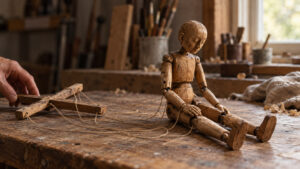
You didn't choose the world you absorbed, or the one behind it. But you can learn to see both. And once you can see the strings, they stop pulling you by default.
Begin with a conversation
If you see yourself in any of this — the over-working, the not-asking, the "I never wanted that anyway," the sense that everyone else just belongs — these are class beliefs running quietly underneath.
One-on-one, we bring them into the open, loosen their grip, and turn each one into a choice — so you can move forward with energy instead of unease.
Begin with a conversation